|
- Use of the Word "Gospel"
At the time of the NT, euaggelion ("good announcement", the word we translate as "gospel") did not refer to a book or writing, but to a proclamation or message. In the non-Christian Greek world, the term was used to denote good news, especially news of a victory in battle; and in the imperial cult, the birth and presence of the emperor was good news for the Roman world. The Septuagint words related to euaggelion translate words from Hebrew bśr, which has a similar scope of proclaiming good news, especially the victory of Israel or the victory of God. More broadly, it can cover the proclamation of God's glorious acts on behalf of Israel.
While there is no evidence that Jesus used this word, it is certain that his disciples did, insisting that the good news is about what God has done in Jesus. This is what Paul does in Romans 1:3-4 by insisting on Jesus' double identity, namely, as one of David's seed according to the flesh, and as the Son of God in power according to the Spirit of holiness through the resurrection from the dead. More generally, for Paul, the heart of the gospel is centered on Jesus' suffering, death and resurrection and his power for justification and ultimately salvation (Rom 1:16).
Mark 1:1 opens his account with these words: "Beginning of the Gospel of Jesus Christ the Son of God". The good news of what God has done, once proclaimed to Israel, will now be proclaimed in and through Jesus Christ to all nations (13:10). It is the kingdom or reign of God that is made present by Jesus forgiving sins, healing the sick, feeding the hungry, raising the dead, stilling storms - a kingdom/rule proclaimed in his teachings and parables that seek to highlight and counteract human obstacles. Jesus is a king whom God makes triumphant, even when his enemies have crucified him. Although neither Matthew nor Luke begin in the same way as Mark, their basic gospel perspective is much the same. In Matthew, Jesus proclaims the Gospel of the kingdom (4:23; 9:35; 24:14), and Luke uses the verbal form euaggelizein ("to proclaim the good news") to describe this activity (8:1; 16:16). Since both of these writings begin with two chapters of the infancy story, their version of the good news also involves the marvelous conception and birth of Jesus (e.g., Luke 2:10). Although John has similar content about Jesus as the Synoptics, neither euaggelion nor the verbal form appear. However, 1 John (1:5; 3:11) uses the related term aggelia ("message") which could have been the Johannine designation of what we know as the Gospel according to John.
The 2nd century provides evidence of the use of euaggelion for Christian writings. Since the Gospels were unsigned and untitled, a title was added to them in the late 2nd century such as "The Gospel According to...". It should be noted that many apocryphal writings that are given the title of gospel today (the Gospel of Peter, the Protevangelium of James, the Secret Gospel of Mark, the Gospel of Thomas, etc.) do not present themselves as a gospel.
Finally, it will be helpful for us to keep two distinct categories: "Jesus material" (infancy and passion narratives, collections of sayings, collections of miracles, speeches attributed to the risen Jesus); and "gospels," i.e., complete narratives such as those we encounter in the four canonical writings (covering at least one period of public ministry/passion/resurrection, and combining miracles and sayings).
- Origin of the Gospel Genre
- Origin In The OT And Jewish Developments Derivative From The OT
A model might come from the Book of Jeremiah, where we find the prophet's background and date (1:1-3), an account of his calling, an account of his prophetic sayings or speeches and actions, warnings of impending doom for Jerusalem, and a type of passion narrative. Although the proportion of Jeremiah's oracular speeches is much higher than that of Jesus' sayings in the canonical Gospels, the Book of Jeremiah illustrates the coming together in one work of many of the elements that are found in the Gospels. This literary genre is revived in the 1st century CE with a Jewish work, Lives of the Prophets, which recounts some or many details about the various prophets: birth, signs, dramatic actions, death, and burial place. Probably written in Greek, this work may reflect the influence of the ancient biographies we now describe.
- Origin In Imitation Of Secular Biographies
Among the abundant Greco-Roman literature of the centuries immediately preceding and following the period of Jesus are various types of biographies, e.g., Plutarch's Lives of Famous Greeks and Romans, Suetonius's Lives of the Caesars, Philostratus's Life of Apollonius of Tyana, and Diogenes Laertius's Lives of Ancient Philosophers.
The works that have been proposed as counterparts of the Gospels have divergent tones.
- First, biblical scholars sometimes speak of "aretalogy" (a hymn about the virtues of a hero) as a special genre of biography in which a divine man (theios anēr) with preternatural gifts performs miracles. Unfortunately, it is not clear that such a definable genre existed; and many of the parallels post-date Mark Antony.
- Second, the "laudatory biography" genre aims to show the greatness of the character. In the case of philosophers in particular, the emphasis is on their teachings and the idealization of what is most noble in their lives, in order to encourage appreciation and imitation. Unfortunately, there is so much diversity that it is difficult to arrive at a definition.
- Third, some biblical scholars associate the gospels with the Greek representation of "immortals" and "eternals. Humans (sometimes fathered by gods) could become immortal at death, while eternals were divine beings who descended to earth, lived as humans, and then ascended to heaven. Matthew, Mark and Luke would have presented Jesus as an immortal, while John would have portrayed him as an eternal.
Nevertheless, there are considerable differences between the Greco-Roman biographies and the gospels, including the anonymity of the latter, their clear theological emphasis and missionary purpose, their anticipatory ecclesiology, their composition from the communal tradition, and their reading in the context of communal worship. Mark, in particular, departs from a model of biography that would emphasize the unusual birth and early life of the hero, as well as his triumph - or, if he has been unfairly treated, his courageous and noble acceptance. That said, it is likely that many first-century listeners/readers, familiar with Greco-Roman biographies, would not have made these distinctions and would simply have regarded the Gospels almost as Jesus lives as other great figures.
- Creativity And The Gospels
If Mark is the first Gospel, was the Gospel a unique creation of Mark? While the idea of writing a description of Jesus' career may have been catalyzed by the existence of lives of famous prophets, philosophers, and world figures, what is told about Jesus is hardly governed by a simple desire to provide information or encourage emulation. For the gospel demands a response of faith, as John 20:31 writes: "These signs have been brought to light so that you may believe that Jesus is the Christ, the Son of God, and that believing you may have life in his name." The appearance of the word euaggelion in Paul has a similar purpose: "In short, whether it is I or they, this is what we proclaim and this is what you have believed" (1 Cor 15:11; see also Rom 1:1-4; 1 Cor 11:23-26). This means that Mark was certainly not the first to gather Jesus' material for salvific purposes, even though his complete account is the earliest preserved.
How much ingenuity was needed to construct a complete gospel story about Jesus? The answer depends in part on the historical value of the story: for some biblical scholars, the gospel stories include a good deal of fiction, such as the passion narrative, which is a reflection on the OT; for others, Jesus is a teacher of wisdom, and the miracle and resurrection narratives are propaganda against other miracle workers; for still others, Jesus is a magician with a wisdom teaching attached to make him respectable. If this were so, it would have taken a great deal of ingenuity to arrive at the current accounts. But according to most biblical scholars, much of what Mark tells is based on real events, such as the baptism by John the Baptist, the proclamation of the coming of the kingdom of God, both through speeches and parables that challenged people's ingrained attitudes, the healing of diseases and the casting out of what were considered demons, the antipathy of the Jewish leaders whom he aroused by exercising too much sovereignty over the Law, by claiming to speak for God in a way they considered arrogant, and by challenging the Temple administration with actions and warnings. Jesus would thus himself be the source of the material that eventually became part of the Gospels, no matter how much that material evolved over the decades that separated him from the evangelists.
- Portraits Of Jesus
It is useful to distinguish three portraits of Jesus: the actual Jesus, the historical Jesus and the Jesus of the Gospel.
- A portrait of the actuel Jesus includes everything interesting about him: exact dates of birth and death; revealing details about his parents and family; how he got along with them and how he grew up; how and where he worked for a living before he began preaching; what he looked like; what his preferences were for food and drink; whether he got sick from time to time; whether he was humorous, friendly, and well-liked by the villagers of Nazareth, and so on. We do not have these kinds of details in the Gospels, and it is precisely because they lack detail that many scholars are reluctant to describe the Gospels as biographies or lives of Christ.
- A portrait of the historical Jesus is a scholarly construction based on reading beneath the Gospel surface and stripping them of all the interpretations, enlargements and especially theological developments that may have taken place after Jesus' departure. The validity of the construct depends on the criteria used by the researchers. The portrait of the historical Jesus is a construction based on limited evidence and designed to produce a minimalist view that can be scientifically agreed upon (this is what J.P. Meier is looking for with his work on the historical Jesus). It can only give us a tiny fraction of the details and colors of the actual Jesus, and it will constantly change as the scientific method is refined or revised. Since the results of this research strip the gospel accounts of their catechetical and theological dimensions, the two-dimensional picture that emerges will be singularly lacking in theological and spiritual depth and will almost certainly be partially distorted because it will reflect what the researchers wish to highlight. The idea that the Christian faith should depend on reconstructions of the historical Jesus is a dangerous misunderstanding.
- The Jesus of the Gospel refers to the portrait painted by an evangelist. It derives from his highly selective arrangement of material about Jesus in order to promote and strengthen a faith that would bring people closer to God. The evangelist included only the information that served this purpose, and the needs of the intended audience affected the content and presentation. Therefore, the Gospels written by different evangelists for different audiences in different decades had to be different.
The question arises: how do the portraits of the actual Jesus, the historical Jesus, and the Gospel Jesus correspond to the "real" Jesus, the one who attracted and convinced disciples who proclaimed him throughout the known world? Major aspects of the "actual Jesus" are unreported and therefore unknowable; functionally, therefore, this image of Jesus can only be partially real for subsequent generations. On the other hand, the portrait of the "historical Jesus", because of what it excludes, especially of a religious and theological nature, is the furthest to give us the "real" Jesus. If we admit that the portraits of Jesus in the Gospels preserve significant elements of the "real" Jesus and that their missionary objective is not foreign to his, then these portraits are as close to the "real" Jesus as it is possible to get.
- The Three Stages of Gospel Formation
- The Public Ministry Or Activity Of Jesus Of Nazareth (the first third of the 1st century AD)
The data we have says that he did remarkable things, proclaimed his message orally and interacted with others. Jesus chose companions who traveled with him and saw and heard what he said and did. Their memories of his sayings and actions provided the raw "Jesus material." These memories were already selective since they focused on what had to do with Jesus' proclamation of God, not on the many trivia of ordinary existence (or the elements of the "actual Jesus"). From a practical standpoint, it is important for modern readers to keep in mind that these are recollections of what was said and done by a Jew living in Galilee and Jerusalem in the 20s. Jesus' manner of speaking, the issues he faced, his vocabulary and outlook were those of that specific time and place.
- The (Apostolic) Preaching About Jesus (the second third of the 1st century AD)
Those who had seen and heard Jesus had their faith in him confirmed by the appearances of the risen Christ (1 Cor 15:5-7); they gained full faith in the risen Jesus as the one through whom God manifested ultimate saving love to Israel and ultimately to the whole world - a faith they expressed through confessional titles (Messiah/Christ, Lord, Savior, Son of God, etc.). This post-resurrection faith illuminated the memory of what they had seen and heard in the pre-resurrection period; They proclaimed his words and deeds with an enriched meaning, marked by their new understanding of things, different from a simple enumeration of events. We speak of these preachers as "apostolic" because they understood themselves as sent (apostellein) by the risen Jesus, and their preaching is often described as kerygmatic proclamation (kērygma) designed to bring others to faith. Eventually, the circle of missionary preachers expanded beyond the original companions of Jesus, and the faith experiences of newcomers like Paul enriched what was received and proclaimed.
Another factor at this stage of development was the need to adapt preaching to a new audience. If Jesus was a Galilean Jew in the first third of the first century who spoke Aramaic, by the middle of the century his Gospel was being preached in the diaspora to Jews and Gentiles in the cities in Greek, a language he did not normally speak (if he spoke it at all). This change of language implied a translation in the broadest sense of the word, i.e., a reformulation of vocabulary and patterns that would make the message intelligible and alive for the new audiences. Sometimes the reformulation involved incidental elements, e.g., the reformulation of the Palestinian-style roof through which a hole was opened in Mark 2:4 into a tiled roof familiar to a Greek audience in Luke 5:19. But other reformulations had theological implications, e.g., the choice of sōma, "body" for the Eucharistic component in the Synoptics and in 1 Cor 11:24 (as opposed to the more literal translation sarx, "flesh" in John 6:51 and Ignatius, Romans 7:3). Thus, developments in the tradition of Jesus have fostered the growth of Christian theology.
This second period is thus marked by apostolic preaching. But other elements serve the final product of a Gospel, for example, liturgy or worship which gave rise to baptismal and eucharistic formulas. The shaping of material through catechesis can be detected in Matthew. Communal disputes provided coloring, for example, the struggles with the leaders of the Jewish synagogue (in Matthew and John) and internally with those who cry "Lord, Lord" in Matthew 7:21 (against the spiritual enthusiasts?).
- The Written Gospels (the last third of the 1st century, approximately)
It is likely that some early written collections (now lost) of what was preached appeared in the earlier period, and preaching based on the oral preservation and development of the Jesus material continued well into the second century. But the period 65-100 is when the four canonical gospels were most likely written. As for the evangelists or authors of the Gospels, according to traditions dating back to the second century and reflected in the titles added to the Gospels around 200 or even earlier, two Gospels were attributed to apostles (Matthew and John) and two to apostolic men (i.e., companions of the apostles: Mark [of Peter] and Luke [of Paul]). Yet most modern scholars do not believe that the evangelists were eyewitnesses to Jesus' ministry. It is possible that early traditions regarding the authorship of the evangelists may not always have referred to the evangelist who composed the final Gospel. The early attribution may have been to the person responsible for the tradition preserved and enshrined in a particular Gospel (i.e., to the authority behind the Gospel), or to the person who wrote one of the primary sources for the Gospel.
The recognition that the evangelists were not eyewitnesses to Jesus' ministry is important for understanding the differences between the gospels. For example, how do we explain the contradiction between John placing the cleansing of the temple at the beginning of Jesus' ministry, while Matthew places it at the end? How do we explain the contradiction of Luke's healing of the blind Bartimaeus before entering Jericho, and Mark's after leaving Jericho? However, if neither evangelist was an eyewitness and each received the account of the cleansing of the Temple or the healing of the blind man in Jericho from an intermediary source, neither (or only one) could have known when it occurred during the public ministry. Rather than depending on a personal memory of events, each evangelist arranged the material he received in order to portray Jesus in a way that would meet the spiritual needs of the community to which he was addressing the Gospel. Thus, the gospels were arranged in a logical order, not necessarily in chronological order. The evangelists appear as authors, shaping, developing, and pruning the material transmitted about Jesus, and as theologians, directing that material toward a particular goal.
- Corollaries of this approach to Gospel formation
- The Gospels are not literal accounts of Jesus' ministry. Decades of development and adaptation of the Jesus tradition have passed.
- If the Gospels are not literal accounts of Jesus' ministry, how can these accounts be considered true? Truth, however, must be evaluated according to the purpose for which it was written. The Gospels could be judged untruthful if the goal were strict reporting or accurate biography; but if the goal is to bring readers/listeners to a faith in Jesus that opens them up to the reign or kingdom of God, then the adaptations that make the Gospels less than literal (adding the dimension of faith, adjusting to new audiences) were made precisely to facilitate this goal and thus to make the Gospels true.
- Some ask the question: How do we know that the gospels offer a message that is faithful to that of Jesus? Scholars cannot be sure guides since they disagree widely on the degree of alteration, ranging from major to minor. This is a theological question, so a theological answer is appropriate. Those who believe in inspiration will argue that the Holy Spirit guided the process, ensuring that the Gospels ultimately produced reflect the truth that God sent Jesus to proclaim.
- In the history of exegesis, attempts have been made to harmonize the differences between the Gospels, for example by trying to make a single sequential narrative out of the very different infancy narratives of Matthew and Luke, or out of Luke's account of the appearances of the risen Jesus in Jerusalem and Matthew's account of an apparition on a mountain in Galilee. In addition to the question of whether this is possible, we must ask whether such harmonization is not a distortion. From a faith perspective, divine providence has provided four different gospels, not one harmonized version; and it is to the individual gospels, each with its own perspective, that we must turn.
- In the latter half of the twentieth century, respect for the individuality of each Gospel had an effect on the liturgy or ritual of the Church. In its reform, the Roman Catholic liturgy introduced a three-year lectionary in which, in the first year, the Sunday Gospel readings are taken from Matthew, the second year from Mark, and the third year from Luke. This system replaced a one-year lectionary where, without any discernible theological pattern, the reading was taken one Sunday from Matthew, another Sunday from Luke, etc. An important factor in this change was the recognition that the Gospel pericopes must be read sequentially within the same Gospel if justice is to be done to the theological orientation given to these passages by the individual evangelist.
- The Synoptic Problem
The first three gospels are called "synoptic" because they can be examined side by side (syn-optic). These gospels have so much in common that there must have been some dependence of one or both on the other or on a common written source.
- Statistics and terminology
The whole of Mark's gospel has 661 verses, Matthew 1,068 verses and Luke 1,149 verses. 80% of Mark's verses are reproduced in Matthew and 65% in Luke. The Marcan material found in Matthew and Luke is called the "Triple Tradition". The approximately 220-235 verses (in whole or in part) of non-Marcan material that Matthew and Luke have in common are called the "Double Tradition. In both cases, the order in which this common material is presented and the wording of this material is largely the same, so that dependence on the written rather than the mere oral level must be posited.
- Solutions That Posit One Or More Protogospels
- In the 18th century, biblical scholars suggested (Lessing, Eichhorn) that the three Synoptic Gospels were based on an Aramaic Gospel containing a complete life of Jesus which no longer exists.
- Others have proposed apocryphal gospels would be the source of the canonical gospels. Thus The Secret Gospel of Mark, a conflated form of Mark, is said to have been written before the canonical Mark (Smith, Koester). Unfortunately, the only two small fragments of it that we have can be understood as dependant on the canonical gospels. It has also been proposed (Crossan) that a shorter form of The Gospel of Peter is the source of the passion narrative of the four canonical Gospels; unfortunately, most biblical scholars believe that this apocryphal writing is dependent on the canonical Gospels.
- Some biblical scholars point to Papias, an early second century bishop, who wrote: "Matthew arranged the sayings in Hebrew [=Aramaic?] in order" and thus argue that he was not talking about the Matthew we know, but about an earlier collection (sometimes referred to with the acronym M) from which Mark drew, as well as the canonical Matthew (either directly or through Mark). This hypothetical collection would contain what cannot be easily explained by deriving Mark from the canonical Mattheu or vice versa.
- Other biblical scholars see the need for a more complex multi-document theory, e.g., the source was not simply the Aramaic M but a Greek translation of M, plus an Aramaic collection of sayings translated into Greek. Oral sources alongside written sources are also proposed. In this line, Boismard detects four source documents used by the synoptic evangelists, not directly but at a pre-gospel level:
- Document A, of Palestinian and Judeo-Christian origin around the year 50
- Document B, a reinterpretation of document A for pagan Christians written before the year 58
- Document C, an independent Palestinian tradition in Aramaic, very archaic and perhaps the memoirs of Peter - also used in John
- Document Q containing material common to Matthew and Luke.
This type of theory virtually postulates a new source to solve every difficulty. It cannot be proven wrong or right, but most people will find it too complex to assist in the ordinary study of the gospels.
- In fact, the majority of biblical scholars, in their effort to explain the differences and similarities between the Synoptics, rather than postulating non-existent proto-gospels and very ancient apocrypha, rely on a relationship between the existing gospels, i.e., solutions of mutual dependence to which we will now turn.
- Solutions In Which Matt Was The First Gospel, And Luke Used Matt
This hypothesis, which goes back to Augustine in the 4th century, is the earliest explanation; it was generally accepted by Roman Catholics until the mid-20th century, and still has respectable advocates. In this Augustinian approach, the canonical order is also the order of dependence: Matthew was written first, Mark severely abbreviated Matthew, and then came Luke and John, each drawing on his predecessors. In 1789, J. J. Griesbach proposed a theory of dependence in which the order was Matthew, Luke and Mark. The basis of the Matthaean priority proposal is that, since antiquity, Matthew has been considered the first Gospel. Unfortunately, this hypothesis struggles to explain why Mark would omit so much of Matthew's account. Griesbach's answer is that Mark would have wanted to make a condensed account of only those elements on which Matthew and Luke agree. Yet Mark omits the entire Double Tradition where they agree!
There are major arguments against Luke's reliance on Matthew. When Luke and Matthew have almost contradictory accounts, why didn't Luke make an effort to reconcile the difficulty? For example, Luke's infancy narrative is not only very different from Matthew's, but it is also virtually irreconcilable with it on some points, such as Joseph and Mary's home (in Bethlehem in Matthew 2:11 [home]; in Nazareth in Luke 2:4-7, with no home in Bethlehem) and their travels after Jesus' birth (to Egypt in Matthew 2:14; to Jerusalem and Nazareth in Luke 2:22, 39). Or Luke's account of Judas' death in Acts 1:18-19 is difficult to reconcile with Matthew 27:3-10. As for the order, if Luke used Matthew, why does the placement of the Q material (the common material) in Luke differ so much from that in Matthew? This argument becomes stronger if Luke also used Mark (Augustinian thesis), because Luke closely follows Mark's order. Another problem would be that Luke does not report Matthew's additions to Mark, e.g., Mt 3:14-15 (John the Baptist opposes Jesus' baptism); Mt 12:5-7 ("I want mercy, not sacrifice..."); Mt 16:17-19 ("Blessed are you, Simon son of Jonah..."); Mt Mt 21:14-16 ("children shouting in the temple : "Hosanna to the Son of David"..."); Mt 26, 52-54 ("Do you think that I cannot call upon my Father, who would at once put at my disposal more than twelve legions of angels...").
- Solutions Based On Marcan Priority
According to this hypothesis, Mark was written first, while both Matthew and Luke drew from his Gospel independently. The elements common to Matthew and Luke that do not come from Mark are explained by positing the existence of the Q Document (a source reconstructed entirely from the elements common to Matthew and Luke). This is called the two-source theory (Mark and the Q Document). The following diagram compares the Griesbach hypothesis and the two-source hypothesis.
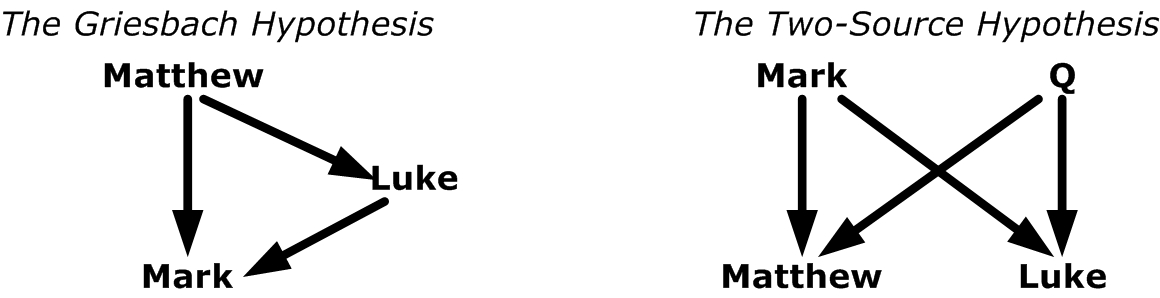
The fundamental argument for Mark's priority is that it solves more problems than any other theory. It offers the best explanation of why Matthew and Luke so often agree with Mark in order and wording, and allows for reasonable assumptions about why Matthew and Luke differ from Mark when they do so independently. For example, neither evangelist likes Mark's redundancies, awkward Greek expressions, unflattering presentation of the disciples and Mary, and embarrassing statements about Jesus. When using Mark, both evangelists develop Mark's stories in light of the post-resurrection faith.
A realistic conclusion is that no solution to the Synoptics problem solves all the difficulties, and we are unable to reconstruct precisely how the evangelists proceeded 1,900 years ago. The process was probably more complex than the most sophisticated modern reconstruction. While we cannot solve all the puzzles, it is realistic to accept and work with a relatively simple solution to the synoptic problem that is largely satisfactory. It is in this spirit that Mark's priority theory (as part of the two-source theory) is recommended to readers of the Gospel.
In accepting Mark's priority, however, the following must be kept in mind:
- Even when Mark was written, the memory of the oral tradition about Jesus did not cease. Papias is a witness to the continuing interest in oral tradition in the second century. Some problems not solved by the two-source theory can be solved by involving the influence of orally transmitted memories. For example, the identical question, "Who is it that struck you?" shared by Matthew and Luke in relation to Mark could be explained by the independent use of a traditional orally known question.
- Accepting the solution that both Matthew and Luke used Mark, we can then study their respective theology by analyzing the changes they made to Mark's account (an example of redaction criticism).
- Even accepting that Matthew or Luke added material to what was copied from Mark, this addition, sometimes from the special material of one or other of these evangelists, need not be dated later than Mark's account. An example would be Matthew 16:17-19 ("Blessed are you, Simon son of Jonah..."), added between elements borrowed from Mark 8:29 and 8:30. The added material, which has a strong Semitic connotation, may well be very old.
- The Existence of "Q"
- What is the Q Document?
"Q" is a hypothetical source proposed by most biblical scholars to explain what has been called above the Double Tradition, i.e., the agreements (often verbal) between Matthew and Luke on elements not found in Mark. Behind this hypothesis is the plausible assumption that the evangelist Matthew did not know Luke and vice versa, and that they must therefore have had a common source. Many precautions must be taken before reconstructing Q. Its content is generally estimated at about 220-235 verses or parts of verses. Independently, however, both Matthew and Luke omit passages found in Mark, so it is plausible that they independently omitted material that existed in Q. Sometimes only Matthew or Luke retain material in Mark; it is also possible that material found only in one of the two Gospels could have existed in Q. We are not sure of the sequence of material in Q because Matthew and Luke do not present it in the same order; nevertheless, most reconstructions follow the Lucan order. Q is normally reconstructed as a written document in Greek, because our only reference is two Greek gospels and the assumption of a purely oral tradition would not explain the large parts of the Double Tradition that are in the same order. Since Matthew and Luke often disagree on the wording of what they derived from Q (any more than they agree on what they derived from Mark), one must study the tendencies of each gospel to determine which version most likely represents a change made by the individual evangelist. Moreover, it is unlikely that there was only one copy of Q to which Matthew and Luke had independent access, and it is possible that some of the differences in wording between Matthew and Luke come from slightly different copies of Q.
The reconstructed Q document consists of sayings and a few parables with an absolute minimum of narrative setting; and thus there is a strong sapiential tone. The discovery of The Coptic Gospel of Thomas, representing a Greek original probably from the 2nd century, shows that there were Christian compositions consisting of collections of sayings. Presumably, as with the other Gospels, these sayings were preserved because they were considered relevant to Christians. The warnings, the woes and some of the parables have a strong eschatological connotation. There is a sense that judgment is imminent; yet several passages in Luke suggest that there will be a period of time when the inheritance received must be put to good use and a highly moral life lived.
- The material of the Q Document
Table of material usually attributed to the Q Document
* The order is that of Luke
| Matthew | Luke | Contents |
|---|
| 3:7b-12 | 3:7-9, 16-17 | JBap, warnings, promise of one to come |
| 4:2b-11a | 4:2-13 | three temptations (testings) of Jesus by the devil (different order) |
| 5:3,6,4:11-12 | 6:20b-23 | beatitudes (different order, wording) |
| 5:44,39b-40, 42 | 6:27-30 | love of enemies; turn other cheek; give coat; give to beggars |
| 7:12 | 6:31 | what you wish others to do to you, do to them |
| 5:46-47, 45, 48 | 6:32-33, 35b-36 | love more than those who love you; be merciful as the Father is |
| 7:1-2 | 6:37a, 38c | judge not and be nor judged; measure given is measure received |
| 15: 14, 10, 24-25a | 6:39-40 | can blind lead the blind; disciple not above teacher |
| 7:3-5 | 6:41-42 | speck in brother's eye, log in one's own |
| 7:16-20 (12:33-35) | 6:43-45 | no good tree bears bad fruit; no figs from thorns |
| 7:21, 24-27 | 6:46-49 | calling me Lord and not doing; hearing my words and doing them |
| 8:5a-10, 13 | 7:1-2, 6b-10 | centurion at Capernaum begs help for sick servant, marvelous faith |
| 11:2-11 | 7:18-28 | disciples of JBap; message to him; praise of JBap as more than a prophet |
| 11:16-19 | 7:31-35 | this generation pleased by neither JBap nor Son of Man |
| 8:19-22 | 9:57-60 | Son of Man has nowhere to lay head; to follow him let dead bury dead |
| 9:37-38; 10:7-16 | 10:2-12 | harvest plentiful, laborers few; mission instructions |
| 11:21-23; 10:40 | 10:13-16 | woe to Chorazin, Bethsaida; whoever hears you, hears me |
| 11:25-27; 13:16-17 | 10:21-24 | thanking the Father for revealing to infants; all things given to the Son who alone knows the Father; blessed eyes that see what you see |
| 6:9-13 | 11:2-4 | the Lord's prayer (variant forms - Matt's longer) |
| 7:7-11 | 11:9-13 | ask and it will be given; if you give good gifts, how much more the Father |
| 12:22-30 | 11:14-15, 17-23 | demons cast out by Beelzebul, strong man guards his palace; not with me, against me |
| 12:43-45 | 11:24-26 | unclean spirit gone out of someone returns and brings seven others, making worse |
| 12:38-42 | 11:29-32 | generation seeks sign; sign of Jonah; judgment by people of Nineveh, queen of south |
| 5:15; 6:22-23 | 11:33-35 | not putting lamp under bushel; eye lamp of body, if unsound, darkness |
| 23:25-26,23, 6-7a, 27 | 11:39-44 | Pharisees cleanse outside of cup; woe for tithing inconsequentials, seeking first place |
| 23:4,29-31 | 11:46-48 | woe to lawyers for binding heavy burdens, building tombs of the prophets |
| 23:34-36, 13 | 11:49-52 | I speak/God's wisdom speaks; Will send prophets who will be persecuted; woe to lawyers |
| 10:26-33; 12:32 | 12:2-10 | all covered to be revealed; fear not killers of body; acknowledging me before God |
| 10:19-20 | 12:11-12 | before synagogues, Holy Spirit will help |
| 6:25-33 | 12:22-31 | don't be anxious about the body; consider lilies of field; Father knows what you need |
| 6:19-21 | 12:33-34 | no treasures on earth but in heaven |
| 24:43-44,45-51 | 12:39-40, 42-46 | householder and thief; faithful servant preparing for master's coming |
| 10:34-36 | 12:51-53 | not come to bring peace but sword; divisions of family |
| 16:2-3 | 12:54-56 | ability to interpret weather signs should enable to interpret present times |
| 5:25-26 | 12:58-59 | settling before going before the magistrate |
| 13:31-33 | 13:18-21 | kingdom of heaven/God, like growth of mustard seed; like leaven woman puts in meal |
| 7:13-14, 22-23; 8:11-12 | 13:23-29 | narrow gate through which few will enter; householder refusing those who knock; people coming from all directions to enter kingdom of heaven/God |
| 23:37-39 | 13:34-35 | Jerusalem, killing the prophets, must bless him who comes in the Lord's name |
| 22:2-10 | 14:16-24 | kingdom of heaven/God, a great banquet, invitees make excuses, others invited |
| 10:37-38 | 14:26-27 | anyone coming must prefer me over family and must bear a cross |
| 5:13 | 14:34-35 | uselessness of salt that has lost its savor |
| 18:12-14 | 15:4-7 | man who leaves 99 sheep to go after lost one |
| 6:24 | 16:13 | cannot serve two masters |
| 11:12-13; 5:18, 32 | 16:16-18 | law and prophets till JBap; not a dot of Law will pass; divorcing wife and marrying another is adultery |
| 18:7:15, 21-22 | 17:1, 3b-4 | woe to tempters; forgive brother after rebuking; Peter, how often to forgive |
| 17:20 | 17:6 | if you had faith like grain of mustard seed, could move mountains |
| 24:26-28 | 17:23-24, 37 | signs of the coming of the Son of Man |
| 24:37-39 | 17:26-27, 30 | as in the days of Noah, so will be the coming of the Son of Man |
| 10:39 | 17:39 | whoever finds one's life will lose it; whoever loses will find it |
| 24:40-41 | 17:34-35 | on that night, of two, one taken and the other left |
| 25:14-30 | 19:12-27 | parable of the pounds /talents |
| 19:28 | 22:38, 30 | followers will sit on thrones judging the twelve tribes of Israel |
- Like a complete gospel or just a collection of sayings?
Some biblical scholars have tried to analyze the material in the Q Document and have detected a low christology in which Jesus appears simply as a sophist or cynical teacher of wisdom, ignoring passages such as the one in which Jesus is presented as the one who baptizes in the Holy Spirit, or as the Son of Man who will be rejected and will have to suffer, but will come back for the judgment. The great mistake of these biblical scholars is to approach the Q Document as a complete gospel, and thus to try to reconstruct the Q Document community, its history, its theology, the place where it was written (usually Palestine or Syria), and its leaders (perhaps prophets), and to distinguish redactional layers with a theological perspective for each. When one considers the set of texts attributed to the Q Document, one notes their disordered character and one would look in vain for a coherent theology. And the fact that it was only preserved by Matthew and Luke in combination with material from Mark supports the idea that it was never more than an additional collection of teachings for those who accepted the story of Jesus.
- Dating
Assuming that Matthew and Luke used both Q and Mark, it is not unreasonable to assume that Q was as old as Mark and existed in the 60s. However, it cannot be given an earlier date because some of the sayings presuppose a period of persecution (Lk 11:49-52) and hostility to the Pharisees and lawyers (Lk 11:39-44, 46-48), which came later in the history of the early Christians.
What to conclude? According to the majority of biblical scholars, the existence of Q (without the many added assumptions) remains the best way to explain the agreements between Matthew and Luke on the material they did not borrow from Mark.
|
Next chapter: 7. Gospel according to Mark
List of chapters
|