Jerome Murphy-O'Connor, Paul. A Critical Life.
Chapter 12: Corinth in Crisis, p. 291-322
(Detailed summary)
When Paul had finished writing his letter to the Corinthians and had handed it over to the Corinthian delegation, he turned his attention to his plan to visit the Macedonian churches and, from there, to go to Corinth toward the end of the summer of 54, where he might spend the winter (1 Cor 16:5–7). But his plans were about to be completely disrupted.
- An Unplanned Visit
Did Paul visit Corinth between 1 Corinthians and 2 Corinthians? The Book of Acts makes no mention of it. Everything hinges on two passages in 2 Corinthians, first 2 Cor 12:14: “Behold, I am ready to come to you for the third time” and 2 Cor 13:1a: “This is the third time I am coming to you.” The question has been raised as to whether Paul is simply alluding to his intention to go to Corinth, or whether he is speaking of actual visits. Fortunately, 2 Cor 13:2 provides valuable insight: “I have said this before, and as I did on my second visit, I say it again today while I am away, to those who have sinned previously and to everyone else: ‘If I return, I will not hold back.’” Thus, “I have said this before” would refer to an event during his second visit, and “I say it again” alludes to the current situation in which he is “absent.” In short, Paul is saying that he is about to pay a third visit to the Corinthians, and that this upcoming visit will not be easy, for he will act without restraint. So what happened? We have a clue that this second visit was not a pleasant one.
- The Mission of Timothy
We have no direct information about what led Paul to make this unplanned visit to Corinth shortly after sending 1 Corinthians. But there is one possible explanation, and it is connected to Timothy’s mission. Moreover, in 1 Cor 4:14–21, we sense Paul’s anxiety when, after tender words for his beloved Timothy, he suddenly lets his anger slip out: “Now, thinking that I would not return to you, some have become puffed up with pride” (1 Cor 4:18), perhaps fearing the fate that might be reserved for Timothy, especially at the hands of the “spirit-people.” At the end of his letter, he returns to the subject: “Let no one, then, look down on him” (1 Cor 16:11). Timothy likely lacked their intellectual sophistication. It is therefore anxiety that Paul feels, expressed in this sentence: “I am waiting for him with the brothers [in Ephesus]” (1 Cor 16:12). Thus, the simplest explanation for Paul’s surprise visit to Corinth is that it was motivated by Timothy’s report.
- What Happened at Corinth?
Much of what happened when Paul arrived in Corinth remains unclear. Nevertheless, let us note certain clues. These concern both the offense and the community’s reaction: (1) an isolated Christian (2 Cor 2:6; 7:12) launched a serious attack (2 Cor 2:1, 3, 4) against Paul personally (2 Cor 2:5, 10); (2) the church members did not show the personal loyalty and enthusiasm that Paul expected (2 Cor 7:12). Their fault was serious enough to warrant repentance (2 Cor 7:9). Yet they managed to convince Titus of their innocence (2 Cor 7:11). It is therefore likely that the incident was caused by an intruder.
But how can we explain that an intruder would have insulted Paul to the point of deeply wounding him without the members of the community reacting? A plausible answer is that this visitor was a delegate whom Antioch had sent to exercise its authority over a church founded by Paul in its name. Had Paul not previously warned the Philippians of the danger posed by the Judaizers who followed him throughout Europe (Phil 3:2–4:1), and was this not the very reason he was planning to visit the churches in Macedonia to investigate the situation? In this context, it is possible that the news Timothy reported to Paul was that the Judaizers were far ahead of him and had already made inroads in Corinth; and this could mean that they had perhaps passed through Philippi and Thessalonica before heading to Corinth.
What, then, should Paul do? While he could count on the unwavering affection of the Macedonians, the same could not be said of the Corinthians, especially on the part of the “spirit-people.” His strategy was therefore to send Timothy and Erastus to Macedonia, while he would set sail for the port of Cenchreae for a personal visit to Corinth. If that community fell into the hands of the Judaizers, the encirclement of the churches he had founded would be complete, and Ephesus would certainly follow soon.
The confrontation in Corinth with the leader of the Judaizers was undoubtedly dramatic. The position he took must have been very similar to the one he had taken in Galatia. According to him, Paul was a dishonest representative of the church that had sent him to proclaim the common faith. A traitor to his mission, he was preaching his own ideas, not the common Gospel. The contemptuous tone with which these slanders were uttered added insult to injury. Paul leaves no doubt that he had been deeply humiliated and that his authority had been challenged in the most radical way possible.
- The Neutrality of the Corinthians
What upset Paul most was the attitude of the Corinthians, who were not quick to support him. In fact, they cared little about the position of the church in Antioch and were sufficiently proud of their own identity, having learned Paul’s lesson about local churches well; and they cared little about their ties to Jerusalem. But it was not the same for Paul. To him, the Corinthians were his children, whom he had fathered in the faith (1 Cor 4:15), and they should have preferred him above all others. And their silence suggested that they were ready to listen to the message of the Judaizers. And the “spirit-people” were perhaps behind the refusal to let Paul dictate their faith (2 Cor 1:23); the wound left by 1 Corinthians was no doubt still raw.
All of this created a dilemma for Paul. Should he remain in Corinth to counter the arguments of the Judaizers, or go to Macedonia where they were still active? He thought it best to give the Corinthians some breathing room and decided to leave. Where did he go?
- A Journey to Macedonia
Based on 2 Corinthians 2:12–13, Paul would have left Corinth to go to Macedonia, as his original plan had intended, and from there would have returned directly to Ephesus. This hypothesis is supported by the difficult experience Paul may have had in Corinth: if he found it hard to control the Judaizers in Corinth, how would Timothy and Erastus, who had less authority, manage to do so in Macedonia? To get there, traveling by sea was out of the question: the Etesian, a north wind, made navigation difficult, almost impossible during the three summer months. The overland route stretched 580 km to Thessalonica, a journey of about three weeks fraught with the danger of wild animals such as bears, wolves, and wild boars. In Thessalonica, his fears regarding the Judaizers did not materialize. On the contrary, the Macedonians’ commitment to the collection for the poor in Jerusalem revealed that they were fully on his side (2 Cor 8:1–4). And even their cold reception of the Judaizers explains why the latter quickly went to Corinth. The contrast between the Macedonians’ faithfulness and the Corinthians’ mocking neutrality intensified the bitterness Paul felt toward the latter.
Perhaps under the influence of Timothy, who had likely remained in Macedonia, Paul had the wisdom to realize that it would be counterproductive to return to Corinth, consumed by anger (2 Cor 2:1). That could only make the situation worse and cause even greater damage. So he decided to change his plans, even if it gave the Corinthians another excuse to criticize him. He found a ship leaving from Neapolis for Troas. From there, he had 350 km left to walk to Ephesus. He could have returned home in early August.
- The Mission of Timothy
- The Painful Letter
Since leaving Corinth, Paul felt it was important to explain how he felt after the difficult events that occurred during his visit: “So it was with great distress and a heavy heart that I wrote to you, with many tears, not to make you sad, but so that you might know the deep love I have for you ” (2 Cor 2:4). This letter has been lost and cannot be reconstructed in detail. He does not seem to have revisited the issue of the Judaizers, but rather focused exclusively on his own personal relationships with the Corinthians (2 Cor 2:9; 7:12). His strategy was to win their sympathy by revealing how their betrayal had hurt him. This letter sought to move them, while also delivering a brutal shock. Once the letter was sent, Paul must have feared its impact, not knowing if it would do more harm than good.
The letter was entrusted to Titus (2 Cor 2:13; 7:6), the Christian of pagan origin who had been with him at the Jerusalem Council in the fall of 51. This was a wise choice, for Titus had participated in the debates on circumcision in Jerusalem and knew the apostles’ position and the danger of legalism, and thus could refute the distortions of the Judaizers.
- Departure for Troas
After his return to Ephesus, Paul’s situation was not without its difficulties. In 1 Cor 16:9, he had already mentioned that he had many adversaries. It is likely that they were the ones responsible for “the affliction we suffered in Asia,” a trial so terrible that “we despaired even of life itself; we felt we had received the death sentence ” (2 Cor 1:8b–9). This wording suggests less a legal conviction than Paul’s conviction that his days were numbered. The introduction to this episode, “we do not want you to be unaware” (2 Cor 1:8a), indicates that this situation occurred fairly recently and that the Corinthians are learning of it for the first time. It is difficult to avoid the conclusion that this happened after Paul’s return from his brief visit to Corinth. The clues converge to form a coherent picture. By the time Titus was sent to Corinth, opposition to Paul in Ephesus was intensifying. A sudden intensification of hostility forced Paul to leave the city. He went north to Troas, where he began a new mission. And according to 2 Cor 2:13–14, it was in Troas that Paul had arranged to meet Titus to receive news from Corinth.
Regarding the difficult events prior to Paul’s departure, the Acts of the Apostles recounts a violent incident: the riot instigated by Demetrius the silversmith (Acts 19:23–40). Unfortunately, Luke’s account contains contradictions, and one can see Luke’s strategy of presenting, in a striking scene, Paul’s rehabilitation by the city authorities and the victory of Christianity over paganism. This is a deliberate attempt to persuade the reader that Paul was not driven out of Ephesus. One immediately suspects that, on the contrary, this is exactly what happened!
Two factors influenced Paul’s choice of Troas as the area for his new apostolate. The first was personal: the city had to be on Titus’s return route from Corinth. The second was strategic. The missionary expansion of the Church of Ephesus had until then been limited to localities within a week’s walk of the capital of Asia. Paul therefore decided to expand his work, and his two visits to Troas had shown him the importance of a local community that could serve as a link between the churches of Asia and those of Europe. Moreover, Troas would provide him with the vast urban environment in which he worked most effectively. In Paul’s time, Troas was “one of the most important cities in the world,” a Roman colony founded by Augustus and surrounded by an imposing wall 8 km long. Due to its strategic location as a crossroads for trade between Asia and Europe, it enjoyed great prosperity. Its population is estimated at between 30,000 and 40,000 inhabitants. Paul’s ministry in Troas likely lasted less than a month, but he suggests it was fruitful—“despite the opportunity, I took my leave of them” (2 Cor 2:12–13)—and the existence of a Christian community in Troas is inferred from Acts 20:7–12.
- The Report of Titus
According to 2 Corinthians 2:13–14, Paul did not find Titus in Troas as expected, so he hurried to set sail for Macedonia before the waterways closed for the winter. On this journey, Paul was certainly accompanied by Timothy, since in 2 Corinthians 1:1 he uses the word “we.”
The beginning of his stay in Macedonia seems difficult: “In fact, when we arrived in Macedonia, we had no rest, but every kind of distress—struggles on the outside, fears on the inside” (2 Cor 7:5). Having not yet received news from Titus, he must have been in a state of extreme tension. He certainly stopped in Philippi to visit the church he had founded there. This visit was no doubt brief, and he had to travel the 150 km separating him from Thessalonica, and it was probably in that city that Titus made his appearance. It was therefore there that Paul decided to spend the winter.
All we know of Titus’s report is what Paul tells us in 2 Cor 7:7–16. Paul is elated. It seems that this Painful Letter had achieved its purpose and that the Corinthians’ repentance was expressed through their action against the intruder. Paul can now say: “I rejoice that I can rely on you in everything ” (2 Cor 7:16). Numerous clues in chapters 1 through 9 of the Second Epistle to the Corinthians show that Titus was an attentive observer and a perceptive critic of what was happening in Corinth, and that he gave Paul a very precise report. We must now attempt to reconstruct the gist of his remarks.
- Judaizers and Spirit-People
After assuring Paul of the Corinthians’ affection, Titus provided proof of their change of heart by detailing the measures taken against the man who had insulted him. The nature of the punishment is not specified, likely because there was only one possibility: total ostracism. The believers simply refused to have anything to do with him. Paul was sensitive enough to feel the impact of such isolation. So he asked that the offender’s punishment be lifted and that he be reinstated into the community (2 Cor 2:6–8). His intention may have been to reconcile with those who were hostile toward him.
Nevertheless, the news reported by Titus is troubling. We have seen previously that the individual who had insulted him was most likely an emissary from Antioch. This is confirmed by the nature of Paul’s response in 2 Cor 1–9; the intruders were Jewish Christians. Only a church could send letters of recommendation to another (2 Cor 3:1), and they presented themselves as “ministers of the new covenant ” (2 Cor 3:6). They had chosen this title in order to harmonize their belief that the eschaton had been inaugurated in Christ with their conviction, inspired by Jer 31:33, that the Law retained permanent validity. Their emphasis on the role of the Law is underscored by the abrupt introduction of “on stone tablets” (2 Cor 3:3) instead of the expected “on scrolls.”
Among their opponents, there are also references to “spirit-people.” The accusation that Paul’s Gospel was veiled (2 Cor 4:3) can only have come from those who regarded Paul as having an unremarkable personality and a dull presentation (2 Cor 10:10), that is, from those who preferred the more speculative approach advocated by Apollos, itself based on Philo. The sophisticated and nuanced use of the terms “life” and “death” in 2 Cor 2:16 finds its equivalent only in Philo, as does the language of 2 Cor 6:14–7:1. The attitude toward the body in 2 Cor 5:6b is typically Philo-like.
Several clues suggest that these two groups were not acting as separate groups, but had formed an alliance against him. When the Judaizers arrived in Corinth, their first act would have been to probe the weaknesses of the community Paul had built. In order to operate from within, they needed to be welcomed by someone, and prudence would have advised them to seek out a group already at odds with Paul. In principle, this group should have been more receptive than others to an alternative form of Christianity. Recall that the “spirit-people” had been the target of Paul’s criticism in 1 Corinthians and would have felt humiliated. Naturally, their pride drove them to seek revenge. If Apollos had remained in Corinth, they could have formed an alternative church, but he had left them to join Paul and seemed hardly inclined to return (1 Cor 16:12). Such a betrayal, for which they might have held Paul responsible, had only exacerbated their bitterness.
Beyond this negative common ground, the two groups shared an interest in Moses. For the Judaizers, he was the great Lawgiver, whose words held eternal value. For the adherents of spiritual Christianity, nourished by a form of Philonism, he represented much more. Philo regularly presents Moses as “the wise man par excellence” (Legum allegoriae 1, 395), embodying all Hellenistic virtues as “king, lawgiver, high priest, and prophet” (De vita Mosis 2, 3). Having detached himself from the body (De confusione linguarum 82), Moses penetrated the mysteries of God, which he was then able to reveal and teach (De gigantibus 54). In short, Moses was everything to which the spirit-people aspired. Thus, a beautiful bond formed around Moses.
In order to win over the believers in Corinth, the Judaizers had to make some concessions. They quickly realized that these believers’ hostility toward Paul stemmed from his inability to meet their expectations regarding religious leadership. Consequently, the intruders were led to highlight their own superior qualifications. They proclaimed their credentials (2 Cor 4:5; 10, 12) by publicizing their visions and revelations (2 Cor 12:1), as well as their miracles (2 Cor 12:12). If they had not already been familiar with them, they would have adopted the conventions of Hellenistic rhetoric. At length developed themes, tinged with mystery, would have appealed to the sensibilities of the believers.
Thus, the Judaizers had now consolidated their base among the discontented elements of the community. There was danger in the making.
- Travel Plans
Titus likely reported that Paul was unable to keep his word, particularly regarding his travel plans. He told them one thing (1 Cor 16:5–6) and did not do it. Then he promised them something else (2 Cor 1:15–16), and again he did not do it. Instead, he wrote them a letter. All these things may seem trivial—why did they cause discontent?
When Paul responds: “Did I act rashly in making this decision? Or are my plans merely human plans, so that there is both ‘Yes’ and ‘No’ within me? ” (2 Cor 1:17), it becomes clear that Paul was accused in Corinth of having the fickleness of a flatterer. To some, Paul could not be trusted. Consequently, he could be neither a friend nor an authentic leader. The atmosphere had become toxic. Titus must have warned him that every word and every gesture of his was liable to be deliberately misinterpreted (2 Cor 1:12–14). From what we already know, only “spirit-people” were capable of such malice.
- Financial Assistance
The same contemptuous attitude is evident in the criticisms leveled at Paul’s financial dealings with the Corinthians. This issue had been addressed in 1 Corinthians and provided yet another reason to use it as a weapon against Paul. It gave them the opportunity to highlight another aspect of Paul’s inconsistency and to turn a suspicion of unreliability into an accusation that Paul did not practice what he preached. He had refused, and continued to refuse, an act of love.
The social glue that bound the inhabitants of the Greco-Roman world was the reciprocity of favors. The mere possession of wealth had no value. It was through its distribution that it was transformed into status and power. Offering a gift was a public gesture, an assertion of superiority, a call for respect. For the recipient, no duty is more compelling than that of showing gratitude. The gift had to be returned. If the reciprocity was greater, the original recipient benefited. If it was equal, both parties remained on equal footing. On the other hand, if the reciprocity was less, the recipient became a client, with an unfulfilled obligation toward the giver. Refusing a gift, though theoretically possible, was not a realistic option. The obligation to accept was therefore generally honored, even if, in many cases, it was done negligently, carelessly, and reluctantly.
In Corinth, those who could grant favors to Paul belonged to the elite, among whom he had made his first converts. Their offer to help him could be justified not only by the customs of the time, but also by the fact that he had been of service to them. In Corinth, they were his oldest “friends.” The terminology used by Paul does not allow us to determine whether this was a gift or remuneration. This distinction, however, is as superfluous as any discussion of their motives, since Paul refused. Why did he make a decision so contrary to a respected custom of his time?
Paul tells us only that “we endure everything rather than put a stumbling block in the way of the Gospel of Christ” (1 Cor 9:12b). This rather vague justification can only be translated into specific reasons in light of the general principles that guided Paul. His concern to bear witness to his experience of faith prevented him from being compared to the philosophers and religious teachers who expected payment for their teaching. His refusal to conform to their behavior was intended to highlight the uniqueness of his message. His concern for the unity of the community ruled out any action that might have made him a protégé of one faction within it.
This last point becomes clear when we compare Paul’s refusal to accept support from the Corinthians with the warm welcome he gave to the contributions from Philippi, both in Thessalonica (Phil 4:16) and in Corinth (2 Cor 11:9). While one of the gifts could be considered communal, the other was necessarily individual. The distinction changed the situation radically. The gift from the Philippians represented a collective effort. The church had established a common fund to which all could contribute.
The sum of money was brought by an official delegation and presented on behalf of the church. For Paul, this implied that all members of the church had participated, even if some had given more than others. Thus, Paul was able to accept this contribution as a sign of unwavering friendship. His response was addressed to the entire church (Phil 4:10–20). In Corinth, on the other hand, since Paul resided there, all the gifts were very personal. Lodging meant someone’s home; a meal meant someone’s kitchen. How was Paul to respond to such a multitude of individual gifts? According to social norms, he should have divided his time and energy so that those who had contributed the most would receive the most. The poor and needy would have stood no chance against the resources of the elite. Even with the best of intentions, the rich would have monopolized Paul’s attention, to the detriment of the community’s real needs. It is therefore hardly surprising that he refused them all.
The Corinthians were certainly aware of the arrival of the delegation from Philippi with gifts for Paul. Paul was compelled to explain to the Corinthians the reasons for his refusal of their gifts, while accepting those of the Philippians. In light of 1 Cor 9:1–12a, it would appear that he introduced his explanation by asserting his authority, emphasizing his right to be supported. Such a paradoxical approach likely did not contribute to the clarity of his argument. To people of good will, the distinction between them and the Philippians seemed perfectly logical. Others, however, among the elite, felt aggrieved. Their quest for prestige within the community had been thwarted. It was easy for them to ignore the explanation and focus on the facts: Paul was refusing their gifts while accepting those of others.
Titus must have been informed that criticism of Paul had become commonplace. His report to Paul therefore had to mention how Paul’s attitude toward financial support was being increasingly and seriously misrepresented.
- The Collection for Jerusalem
The reason Paul did not address the issue of his personal finances in 2 Corinthians 1–9 is that the matter of the collection for the poor in Jerusalem had been raised during Titus’s visit to Corinth. The Corinthians had never been officially informed of this collection. They heard about it by chance, presumably from Chloe’s people (1 Cor 1:11). Only in this way can we understand a) why Paul commends them for taking the initiative to participate in this collection, and b) why they needed to ask for instructions on the details of the organization, which Paul provides in 1 Cor 16:1–4.
For Titus, this collection provided him with the perfect ad hominem argument to demonstrate to the Judaizers Paul’s love and concern for the mother church in Jerusalem. They could not oppose this project without endangering the survival of their fellow countrymen in Jerusalem. Once Titus was convinced that the Corinthians had accepted the rebuke of the Painful Letter, it would have seemed natural to him to tactfully remind them of their commitment to the collection, a gesture that the Judaizers could only approve of (2 Cor 8:6)! At that precise moment, Paul, the Corinthians, and the Judaizers would have been in agreement, and the enthusiasm of Titus’s report becomes more understandable.
- Judaizers and Spirit-People
- Winter in Macedonia
Since winter had set in by the time Titus returned from Corinth, it was no longer necessary for Paul to respond immediately to the situation in Corinth. The weather conditions gave him time to reflect on his response. This time, he had the added advantage of having Timothy by his side, who proved to be a much better co-author than Sosthenes had been for 1 Corinthians. It was therefore no earlier than March or April of the year 55 that the letter (2 Cor 1–9) was sent.
- Co-authorship
Sosthenes’ contribution to 1 Corinthians was limited to chapters 1:18–31 and 2:6–16. He seems to have been one of those people who were quick-witted and perceptive in conversation but whose written expression proved complex and overly subtle. Paul gave him two chances, then, irritated, parted ways with him; in addition to these collaborative passages, we find Paul’s own straightforward wording, explaining what he was trying to express (2:1–5; 3:1–4). Timothy, who was much closer to Paul, thus exerted a greater influence on him. Clearly, his role in the composition of chapters 1 through 9 of 2 Corinthians was far more significant.
While 1 Corinthians is a letter written in the first person singular, where the sudden appearance of the first person plural must be explained, 2 Corinthians (chapters 1–9) presents exactly the opposite case. 74% of the letter is written in the first person plural, and only 26% in the first person singular. These latter passages deal with situations in which Timothy was not involved, namely the consequences of the brief visit (2 Cor 1:15–17; 1:23–2:13; 7:3–12) and the matter of the collection in Corinth (2 Cor 8:8–15; 9:1–15). The specific reference to the first-person plural may vary, but there is no need whatsoever to exclude Timothy. He and Paul collaborated effectively and regularly, particularly in the significant section devoted to the apostolate (2 Cor 2:14–7:2), but the nature of certain passages compelled Paul to adopt a very personal tone. These digressions sometimes tended to drag on. Each time, however, Timothy managed to bring Paul back to the task of collaboration, which ultimately resulted in the most extraordinary letter in the New Testament.
- Weaning the Spirit-People from the Judaizers
Unlike 1 Corinthians, where Paul addresses the most difficult issue right away after some rather superficial expressions of thanks (1:4–9), 2 Corinthians (1–9) begins with great caution and subtlety, setting the tone for the letter. The extreme care taken in its composition reveals a refinement born of long reflection and numerous drafts.
When we analyze the style of 2 Corinthians, we note that Paul departs from his usual approach, for example by placing the thanksgiving at the end, not at the beginning. It is unlikely that the Corinthians were unaware of the systematic way in which Paul had reversed his usual pattern. Many of them, considering themselves intelligent, had one or two letters of thanksgiving for comparison: the previous letter (see 1 Cor 5:9) and 1 Corinthians. It would have been difficult for them to avoid the (justified) conclusion that Paul was sending them a subtle message. First, this suggests that he could not express unequivocal gratitude for the state of the church in Corinth. A breach has been repaired (2 Cor 7:5–16), but difficulties persist, and Paul’s subversion of the traditional thanksgiving foreshadows a similar manipulation of Philonic vocabulary in the body of the letter. Furthermore, Paul’s unusual focus on his own experience foreshadows the letter’s major theological theme: suffering and weakness, not power and eloquence, are the hallmarks of the true apostle.
Paul’s dual strategy aimed not only to reestablish his authority but also to sow discord among the believers, particularly the “spirit-people” and the Judaizers. To this end, he offers a critique of the Mosaic covenant in terms to which the believers would be particularly sensitive, while presenting the Christian covenant in a light that would be favorable to them.
In 2 Cor 3:7–18, Paul focuses on the figure of Moses, an instrument used by the Judaizers to win the favor of the “spirit-people.” The polemical dimension of his commentary on the passage “When Moses had finished speaking to them, he put a veil over his face ” (Ex 34:34–35) is clearly evident in the contrast he draws between his own behavior and that of Moses: “we act with confidence and boldness, not like Moses, who put a veil over his face” (3:12–13). These implications are well highlighted by Philo, for whom only those who do evil hide themselves. Thus, by simply presenting himself as he was, without any pretense, Paul implicitly claimed a whole range of qualities that Moses must have lacked, since he concealed his true nature by veiling himself.
Having thus sown doubt in the minds of the believers regarding the stature of Moses, associated with the old covenant, Paul then links the fulfillment of the latter to intellectual blindness (3:14–15). The presence of Jews in the Corinthian community shows that they had recognized a shortcoming in their former way of life based on the Law. Once blind, they now see. Why, then, Paul suggests, would these spiritual beings condemn themselves to the darkness of intellectual rigidity, when they could receive the light of the true glory of the Gospel?
In 3:17, Paul shifts from indirect criticism to persuasion by appropriating two key terms from the lexicon of “spirit-people,” namely “spirit” and “freedom.” While in 3:14–15 he associated the Law with intellectual blindness—the vice they abhorred most—here he identifies the Gospel with the values they held most dear. “Spirit” evokes Philo’s heavenly man, and for Philo, “freedom” carries connotations of virtue, perfection, and wisdom.
In short, with Timothy’s help—and perhaps Apollos’s as well—Paul was able to penetrate the religious world of the “spirit-people” and subtly undermine their convictions. His subtle denigration of Moses eroded the common ground on which the Judaizers stood. His reformulation of the Gospel is carefully calculated to harmonize with the Philo-inspired perspective that the believers had received from Apollos, while gently but firmly reshaping it. Paul’s discreet and indirect approach helped avoid the risk of a backlash, such as the one that followed 1 Corinthians.
- Manifesting the Life of Jesus
The attitude of the “spirit-people” is summed up by the shocking statement: “Cursed be Jesus” (1 Cor 12:3). For they found repugnant the idea of a crucified savior associated with the name Jesus, and they preferred to speak of the “Lord of glory,” a superhuman being who came from above (1 Cor 2:8). For Paul, the historical Jesus could not be separated from the Christ of glory. For only a being of flesh and blood, anchored in space and time, could demonstrate the real possibility of a restored humanity as proclaimed by the Gospel. Jesus did not merely preach love; he lived it.
Even though the Gospels recount Christ’s passion and his death on a cross, the early church was content merely to mention the fact that Jesus had died. For Paul, however, it was important to recognize how Jesus had died—crucified like a slave—which, of course, was a stumbling block to the Jews and folly to the Gentiles (1 Cor 1:23). The “spirit-people” preferred to set this aspect aside, as it did not fit with a philosophical approach to religion. As for the Judaizers, they could align themselves with the “spirit-people” by focusing on a life compatible with the Lord of glory.
It was likely while reflecting on Jesus’ ministry that Paul made the connection to his own situation, which led him to a new and much deeper understanding of Christ’s ministry. Thus he was able to understand that God had chosen to immerse him in a world marked by sin (2 Cor 5:21), to make him suffer the consequences of sin, even though he had not sinned. He was humanity’s savior from within by accepting its condition and transforming it. He became a human being like the rest to reveal to them all that humanity could become.
Other passages in 2 Corinthians emphasize Christ’s free cooperation with God’s plan (2 Cor 5:14; 8:9). His life and death constituted a deliberate self-sacrifice for the benefit of others. Before Christ, it was taken for granted that the primary goals of human existence were survival, comfort, and success. Christ’s radical selflessness introduces a new way of life that can be seen as the “death” of selfishness. Related to this is Paul’s presentation of Christ as “the image of God,” a phrase taken from Gen 1:26–27 (2 Cor 4:4). Thus, the authentic human being is a creator like the One whom he resembles, insofar as he enables others to act and develop.
Hence, Christ is the New Adam, but he is so through poverty and his ignominious situation. His entire life amounts to dying on various levels (2 Cor 4:10), but in doing so, he brings into existence “a new creation” (2 Cor 5:17). Reflecting on this, Paul could not help but see in it the archetype of his own situation. By identifying with the historical Jesus, he realized that they shared a common experience of suffering. Thus he could accept that suffering is an integral part of the human condition. Moreover, this suffering could now have meaning: it was an extension of Christ’s sacrifice (2 Cor 2:15). And in this way, Paul found himself proclaiming Jesus to the whole world, not only through words, but more fundamentally through his conduct. This is how the life of Jesus is manifested through the body of believers.
This extraordinary statement constitutes the climax of 2 Corinthians and the deepest insight ever articulated regarding the meaning of suffering and the nature of authentic ministry. Death loomed over every step Paul took; he could die at any moment. Heading toward a fate that seemed inescapable, he perceived his life as an “agony,” which he identified with that of Jesus, who too had foreseen his death. The authentic humanity of Jesus became visible through him and through the believers. This explicit presentation of the minister as alter Christus is unique in the New Testament. It was imposed on Paul by the denial of the reality of Jesus’ earthly existence by the “spirit-people” / Judaizers, and by their contempt for Paul’s ministry.
- Co-authorship
- Plans for the Collection
The Corinthians’ initial enthusiasm for the collection for the poor in Jerusalem evaporated amid the heated atmosphere of the dispute between the various factions in the community. Furthermore, offended by the way they were singled out in 1 Corinthians, the “spirit-people”—potentially the major donors—likely retaliated by refusing to take part in a project that was dear to Paul’s heart.
2 Corinthians 8–9 reveals the best of Paul’s religious leadership. Even if he sometimes has to stretch the truth, he praises everything he can praise while avoiding any criticism. He explicitly states that he is not forcing anyone to contribute (8:8a), but is merely expressing an opinion (8:10). If he refers to the generosity of the Macedonians, it is simply an incentive. He emphasizes their attitude, which is more important than the amount of the gift (8:12). Even though he mentions the possibility that they might be humiliated by the generosity of the poorer people of Macedonia (9:4), he is quick to add that he absolutely does not want to extort anything from them (9:5).
Previously, the Corinthians had given their consent without doing anything further. This time, Paul did not want to settle for mere words and decided to send emissaries to Corinth, whose presence would constantly remind them of his invitation. There is Titus, responsible for delivering the letter to the Corinthians, who volunteered to oversee the collection (8:17). Joining Titus as a companion is a delegate chosen by the churches of Macedonia, who is described as an exceptional preacher of the Gospel. The third member of the group (8:22) is not named either. His description suggests that he was a close, long-time associate of Paul, with ties to the Corinthians. He may have accompanied Paul on the brief visit, or he may have accompanied Titus when the latter delivered the Painful Letter.
- Once Again a Missionary
According to 2 Cor 9:4, Paul planned to visit Corinth soon—that is, during the summer of 55—to finalize the collection he had been working on for four years. It was clear to him, however, that he could not simply make a brief visit and then return to Jerusalem with the collection: certain issues remained unresolved, and he would need to stay in Corinth for some time. But in the meantime, he needed to give the Corinthians time to take in the letter he was sending them before appearing before them. He was confident that Titus would be able to steer the discussions in the right direction. So the best plan seemed to him to be to send the collection delegates to Corinth with his letter, while he could return for a time to his primary calling: founding churches and preaching Christ where he was unknown (Rom 15:20). And so he set out for Illyria (Rom 15:19).
To get to Illyria, Paul simply had to follow the Via Egnatia westward. The distance between Thessalonica and the border of Illyria is 320 km. If Paul had left in mid-April, he would have been among the Illyrians by the end of the month and could have looked forward to at least three months of intense missionary work before having to head south in August to reach Corinth before winter set in.
- Bad News from Corinth
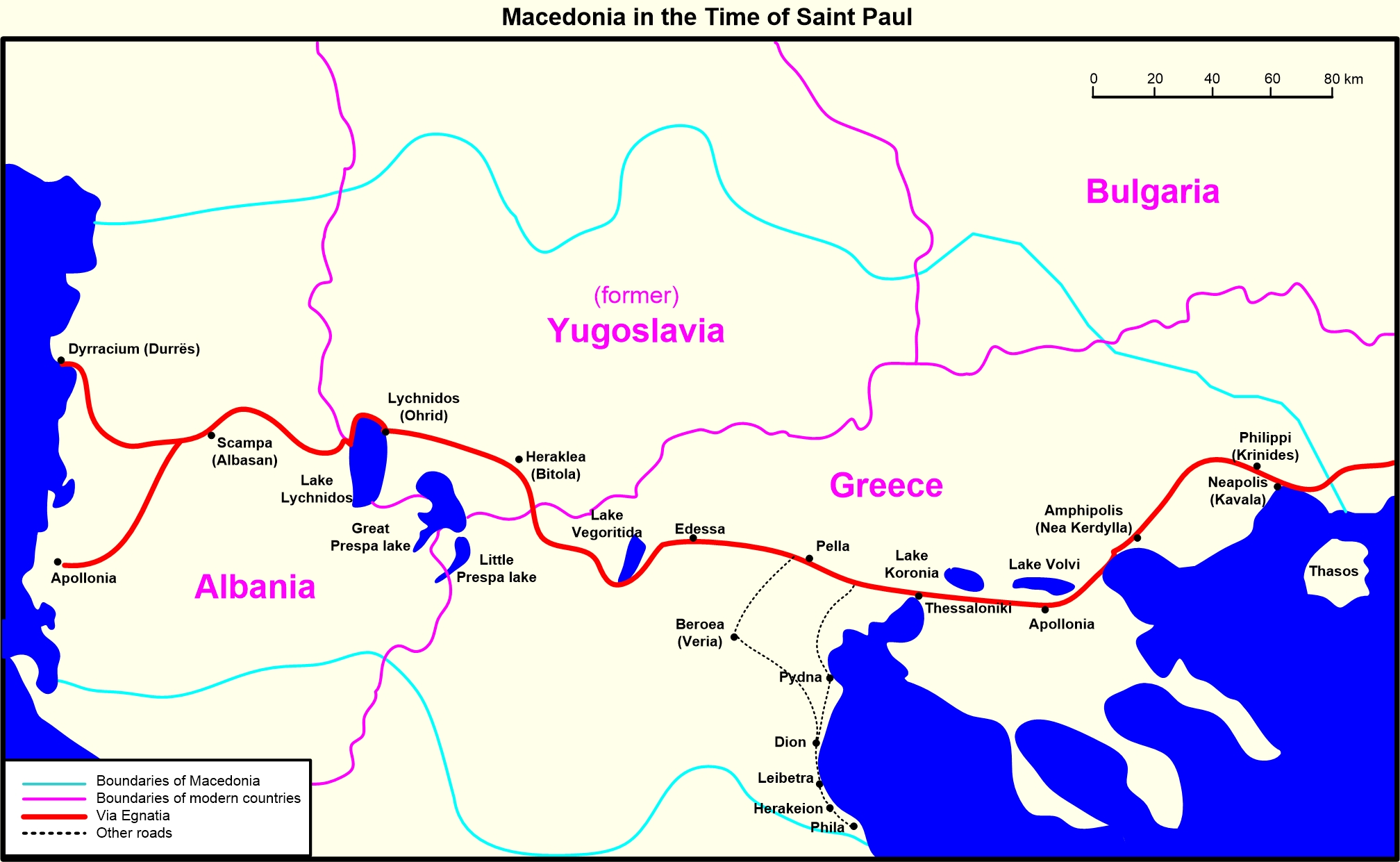
Fig.: Map published by Jerome Murphy-Oconnor, Paul: A Critical Life, using F. Papazolou, Aufstieg und Niedergang der romischen Welt, II, 7/1 (1980).
While Paul was ministering in Illyria, he received a visit from Titus—or perhaps from someone sent by Titus—to inform him that the old criticism of his unimpressive presence and uninspiring preaching was circulating in Corinth (2 Cor 10:10). Recall that 2 Cor 1–9 had two objectives: to create a separation between the Judaizers and the “spirit-people,” and to win the latter over to his cause. It seems that at least the first objective—isolating the Judaizers—was achieved. This would explain why the latter redoubled their criticism of Paul, implying that their spiritual gifts made them superior to Paul (2 Cor 11:5). Moreover, wasn’t the fact that he had not returned to Corinth since his brief visit an expression of cowardice? Finally, the Judaizers seem to have highlighted Paul’s ambiguous attitude toward money: on the one hand, he refuses gifts from the Corinthians, but on the other hand, he solicits them for the poor in Jerusalem. Will this money really go to Jerusalem? By refusing to accept help from the Corinthians, isn’t this a sign that he doesn’t really love them? (2 Cor 11:9)
- Speaking as a Fool
Paul could only view this criticism as a malicious distortion of his motives and actions. His bitter anger was exacerbated by the realization that, if he were discredited, his version of the Gospel would be threatened. Another Gospel risked taking its place. In a state of deep anxiety for the future of the Corinthian community, he hastily wrote chapters 10 through 13 of the Second Epistle to the Corinthians. The reasonable tone and subtle arguments of chapters 1 through 9 give way to an outburst of anger, in which Paul gives free rein to his sarcasm and irony. Thus he writes:
19 For you gladly put up with fools, being wise yourselves! 20 For you put up with it when someone makes slaves of you or preys upon you or takes advantage of you or puts on airs or gives you a slap in the face. 21 To my shame, I must say, we were too weak for that! But whatever anyone dares to boast of—I am speaking as a fool—I also dare to boast of that.
The writing of this letter is remarkable and is matched only by the power of its strategy. His opponents forced him to compare himself to them, which led him to display his contempt for their pretensions by subverting rhetorical conventions. After mentioning his education (2 Cor 11:22–23), he parodies the ostentation of the Judaizers by highlighting the situations in which he was humiliated. With remarkable dramatic flair, he concludes his list of “feats” with the gripping account of his humiliating escape from Damascus, lowered from the wall like a defenseless child in a basket (2 Cor 11:32–33).
Parody is not the only weapon in Paul’s rhetorical arsenal. He discredits his opponents’ claims to visions and revelations by recounting his own experience in the third person (2 Cor 12:2–4). This technique distances him from the episode and thus highlights its uselessness for his ministry. This episode did not transform him in any way and provided him with no useful information. The criticism of his opponents is all the more effective because it is implicit. If their experience was identical to Paul’s, it contributed nothing to their ministry.
Chapters 10 through 13 of the Second Epistle to the Corinthians reveal, in an extraordinary way, a Paul rarely seen elsewhere. Here, the rigid control he usually imposed on his passionate nature dissolves under the intensity of his anger. He gives free rein to his emotions and, in doing so, betrays the quality of his education, which he usually denied. The fluidity and creativity of his thought are matched only by the mastery and freedom with which he employs numerous figures of speech. His ease in using rhetorical devices can only be the result of long study and diligent practice. There is little doubt that Paul was raised in a socially privileged environment, which he was destined to honor.
- The Thorn in the Flesh
In 2 Cor 12:7–10, Paul concludes his defense as follows:
7 even considering the exceptional character of the revelations. Therefore, to keep me from being too elated, a thorn was given me in the flesh, a messenger of Satan to torment me, to keep me from being too elated. 8 Three times I appealed to the Lord about this, that it would leave me, 9 but he said to me, “My grace is sufficient for you, for power is made perfect in weakness.” So I will boast all the more gladly of my weaknesses, so that the power of Christ may dwell in me. 10 Therefore I am content with weaknesses, insults, hardships, persecutions, and calamities for the sake of Christ, for whenever I am weak, then I am strong.
The vast majority of biblical scholars view this “thorn in the flesh” as a physical, somatic, or psychological ailment. The only plausible hypothesis is that, by the thorn in his flesh, Paul was referring to opposition to his ministry. His mention of a “messenger of Satan” suggests an external and personal source of suffering, and he had previously described his opponents in Corinth as “servants of Satan ” (2 Cor 11:14–15). In the Old Testament, “thorns” are a metaphor for Israel’s enemies, both internal (Num 33:35) and external (Ezek 28:24).
What constantly troubled Paul was the realization that none of his churches met his expectations. In every community he founded, there was always someone who opposed him: the idlers in Thessalonica, Evodia and Syntyche in Philippi, those paralyzed by caution in Galatia, the resentful in Ephesus, the mystics in Colossae, and those sowing dissension in Corinth. Yet such divisions were contrary to God’s plan, for whom the Church was to manifest the organic unity of a living body.
The biting humor of his self-assessment continues in the presentation of the answer to his prayer in the form of a divine oracle: “My grace is sufficient for you; my power is made perfect in weakness” (2 Cor 12:9a). The paradox is as striking as the meaning is profound. The thorn reminds him that he possesses none of the qualities the world considered essential prerequisites for the success of his mission. Yet he is a channel of divine grace expressed in the power of Christ (2 Cor 12:9b), whose “life” he manifests (2 Cor 4:10–11), and the world is transformed.
- Speaking as a Fool